
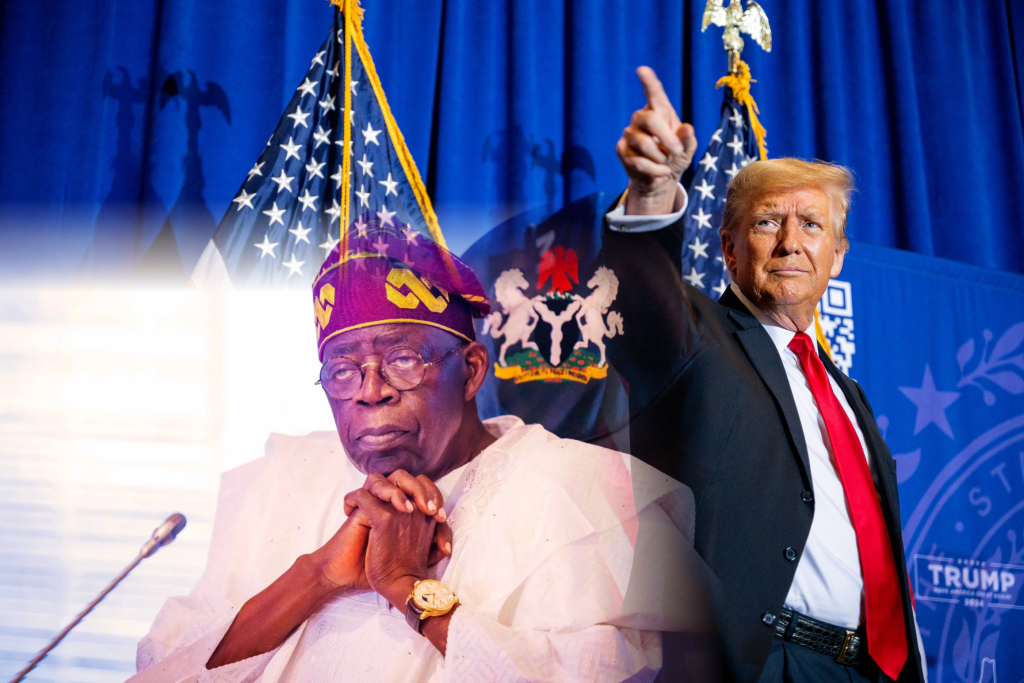
Former U.S. President Donald Trump has sparked a wave of international reactions after threatening military action against Nigeria over what he described as the “slaughter of Christians.”
In a post shared on his Truth Social platform on Friday, November 1, 2025, Trump declared that if Nigeria “continues to allow the killing of Christians,” the United States would “immediately stop all aid and assistance” to the country.
“We may very well go into that now disgraced country, guns-a-blazing, to completely wipe out the Islamic terrorists who are committing these horrible atrocities,” Trump wrote.
“If we attack, it will be fast, vicious, and sweet — just like the terrorist thugs attack our cherished Christians!”
The former U.S. leader further claimed he had instructed the “Department of War” to prepare for possible action, vowing to defend Christians worldwide.
Nigeria’s Federal Government swiftly responded through the Ministry of Foreign Affairs, describing Trump’s comments as “reckless and misinformed.”
The ministry insisted that Nigeria remains a secular state that guarantees religious freedom and protection for all citizens.
“The Nigerian government rejects any insinuation of religious persecution,” the statement read.
“Our security forces continue to tackle terrorism and inter-communal violence affecting all Nigerians — regardless of faith.”
Officials also expressed concern that Trump’s remarks could inflame tensions and undermine counter-terrorism efforts in the region.
Trump’s comments follow renewed international reports about attacks on Christian communities in Nigeria’s Middle Belt and Northern regions.
The former U.S. president, who previously placed Nigeria on a religious freedom watchlist during his administration, has repeatedly accused the country of “turning a blind eye” to the killing of Christians.
Analysts, however, argue that the violence in Nigeria is far more complex, rooted in farmer-herder conflicts, ethnic tensions, and insurgencies like Boko Haram — all of which affect both Christians and Muslims.
Foreign policy observers have described Trump’s language as “alarming,” noting that it marks one of the strongest militaristic threats ever issued toward an African nation by a U.S. political figure.
While some American conservatives praised Trump’s “bold defense of faith,” others warned that his statement could strain U.S.–Nigeria relations, jeopardizing cooperation on counterterrorism, trade, and humanitarian aid.
In Nigeria, many social media users criticized Trump’s tone, viewing it as neo-colonial interference. Others called on the government to use the moment to highlight the real security challenges faced by Nigerians daily.
Trump’s “guns-a-blazing” remark has reignited debates on international intervention, religious politics, and the limits of diplomatic speech.
For Nigeria, the statement underscores ongoing concerns about how its internal crises are perceived abroad — and the potential geopolitical risks of being labeled a “country of concern.”
Whether Trump’s comments translate into real policy action remains to be seen, but they have already sent shockwaves through both political and religious circles.