


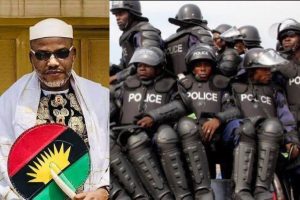
Nigeria’s capital city, Abuja, was thrown into tension on Monday as protesters demanding the immediate release of Mazi Nnamdi Kanu, leader of the Indigenous People of Biafra (IPOB), clashed with security operatives during a nationwide demonstration tagged #FreeNnamdiKanuNow.
The protest, spearheaded by activist Omoyele Sowore and supported by several civil rights groups, defied police warnings and a recent court order restricting gatherings near sensitive government locations.
Despite the restrictions, protesters converged at key points across the city — including Transcorp Hilton, Maitama, Eagle Square, and roads leading to the Presidential Villa.
Security agencies, including the Nigeria Police Force, Department of State Services (DSS), and Nigeria Security and Civil Defence Corps (NSCDC), were deployed heavily across Abuja early in the morning.
Witnesses reported that police used tear gas and fired live warning shots to disperse protesters attempting to march toward the Presidential Villa.
Several demonstrators reportedly sustained injuries or fainted during the chaotic dispersal.
In a related development, Nnamdi Kanu’s lawyer, Aloy Ejimakor, and his brother, Prince Emmanuel Kanu, were allegedly arrested by police officers during the demonstration.
Videos circulating on social media show protesters fleeing clouds of tear gas while chanting solidarity songs and demanding Kanu’s release.
The Nigeria Correctional Service (NCoS) earlier declared all correctional centres nationwide as “Red Zones”, warning protesters to steer clear of its facilities.
Key Hotspots in Abuja
- Transcorp Hilton / Maitama: Initial gathering point for protesters; later dispersed with tear gas.
- Eagle Square / Three Arms Zone: Heavily guarded with barricades and armed operatives.
- Aso Rock Presidential Villa & National Assembly Area: Declared restricted zones; all access roads blocked.
- Shehu Shagari Way: Reports of sporadic scuffles and heavy police presence.
Traffic disruptions were reported across the Central Business District and Maitama, leaving commuters stranded for hours.
Regional Reactions
In the South-East, the protest triggered mixed reactions.
Some residents reportedly stayed home amid fears of violence, while others expressed confusion over whether to join or observe a “sit-at-home” in solidarity.
Businesses in Enugu, Owerri, and Onitsha partially closed as precautionary measures.
Igbo sociocultural groups and community leaders have called for calm, urging the government to engage in dialogue rather than repression.
Nnamdi Kanu has been in detention since his re-arrest in 2021, facing terrorism-related charges. His supporters argue that his continued detention violates previous court rulings ordering his release. The Federal Government insists that Kanu must face trial, citing threats to national unity and public order.
The ruling All Progressives Congress (APC) dismissed the protests as politically motivated, calling them “an attempt by opposition elements to destabilize the country.” However, rights groups like Amnesty International and the Civil Society Legislative Advocacy Centre (CISLAC) have condemned the use of excessive force against protesters.
Activist Omoyele Sowore, speaking before the protest was dispersed, stated:
“We’re here to demand freedom for Nnamdi Kanu and every Nigerian being unjustly detained. Peaceful protest is a right, not a crime.”
A protester interviewed near Transcorp Hilton added:
“We just want justice. Kanu’s case represents the way this government treats its own people — with force instead of fairness.”
Today’s #FreeNnamdiKanuNow protest underscores deepening frustrations over perceived injustice, marginalisation, and the slow pace of judicial processes in Nigeria.
Whether this movement sparks broader nationwide action or is suppressed by force remains to be seen — but it has once again brought Nnamdi Kanu’s name, and the unresolved tensions around his detention, back to the centre of Nigeria’s political conversation.