


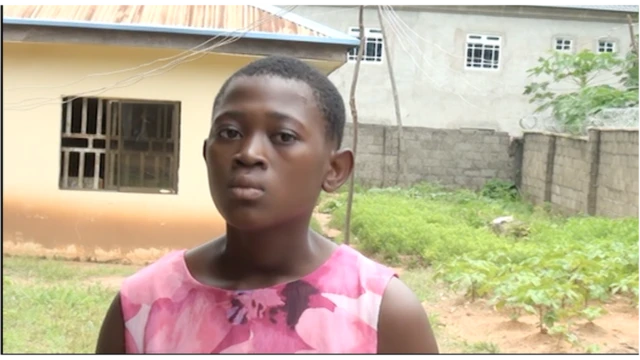
Ochanya Elizabeth Ogbanje was born in 2005 in Ogene-Amejo, a community in Okpokwu Local Government Area, Benue State. She was the last child in a family of 11 siblings.
The community had a primary school (LGEA Primary School, Ogene-Amejo) which, according to reports, fell into disrepair and became nonfunctional around 2011 due to nonpayment of teachers, neglect, and infrastructure decay.
Because of the absence of a functioning primary school locally, many children in that area had to travel long distances or relocate in order to access education.
Sometime around 2012, when Ochanya was about 7 years old, her parents sent her to live with her aunt, Felicia Ogbuja, in Ugbokolo (Benue State).
The stated reason was to enable her access to schooling she could not get in her home community.
From that point, she became under the care/guardianship (in effect) of the Ogbuja household. Her parents continued to provide school fees and provisions.
According to investigative reports and court-related documents, the sexual abuse allegedly began around 2013, when Ochanya was about 8 years old, by Victor Ogbuja, the son in the Ogbuja household.
There are claims that when siblings or other household members tried to raise concern (for example, Victor’s sister reportedly witnessed or raised alarm), the father, Andrew Ogbuja, initially scolded the son.
Over time, Andrew is alleged to have become complicit and, in worst-case accounts, also directly abused Ochanya.
Over several years, Ochanya’s health worsened progressively. Some of the documented symptoms and conditions include:
-
-
Incontinence (urine, fecal matter) — inability to control urination or defecation, requiring diapers for extended periods (some reports say up to four months at a time).
-
Physical weakening / paralysis — in her later condition, she reportedly lost mobility, could no longer walk, and became weak.
-
Repeated hospital visits — her parents often took her to various hospitals; at times she was admitted, then discharged, but the condition would relapse.
-
Diagnostic tests & conflicting reports — at one point, tests (some reports say as many as 17 tests) were conducted that indicated sexual molestation via vaginal and anal routes.
-
Vesicovaginal fistula (VVF) — The official cause of death is often attributed to complications arising from vesicovaginal fistula. VVF is a medical condition where there is an abnormal connection between the bladder and the vagina, leading to continuous leakage of urine. While VVF is more commonly associated with childbirth injuries, in this tragic case, it is alleged to have been caused by repeated sexual trauma.
-
In mid-2018 (some reports place June 2018 as a turning point), Ochanya was brought to Restorer of PathCare Foundation, in Otukpo, a home / caregiving foundation, because her condition had worsened and her home environment could no longer support her medical needs.
In her last days, she reportedly could not walk, speak, or eat well; she was in severe pain. Her legs were said to become paralyzed.
On October 17, 2018, she passed away.
Andrew Ogbuja was arrested in 2018 and charged with multiple counts including rape and culpable homicide (or causing the death of a minor) in relation to Ochanya’s ongoing abuse and the eventual result of her death.
Felicia Ogbuja (the aunt / caretaker) was arrested, particularly by NAPTIP (National Agency for the Prohibition of Trafficking in Persons), due to alleged neglect and non-reporting of the abuses she was aware of.
Victor Ogbuja, the principal accused of sexual assault, went missing or remained at large in many reports, making prosecution more difficult.
In April 2022, a Benue State High Court discharged and acquitted Andrew Ogbuja of the four-count rape charge. The rationale included failure of prosecution to prove guilt beyond reasonable doubt.
The judge noted that investigators did not present matching medical/forensic evidence (e.g. matching DNA from Andrew) and pointed to inconsistencies in autopsy reports.
The court noted that two autopsy reports existed: one from Federal Medical Centre (Makurdi) attributing death to “natural causes” and another from the Nigerian Police forensic lab in Lagos linking the death to sexual abuse complications.
The conflict weakened the prosecution’s case.
In a civil / regulatory case, Felicia Ogbuja was convicted for negligence under the Trafficking in Persons (Prohibition) Act (2015).
The court held she failed in her duty to protect Ochanya, and also that she obstructed the testimony of a key witness (Winifred, sister to Victor) by preventing or interfering with her testifying. She was sentenced to 5 months imprisonment.
Some reports say the sentence was considered lenient given the gravity of the underlying harm.
The acquittal of Andrew Ogbuja despite the serious allegations sparked public and civil society outrage: many saw the ruling as a failure of prosecution, weak evidence gathering, and systemic challenges in sexual assault cases.
The absence or elusiveness of Victor hampered full accountability.
The discrepancies in autopsy reports (i.e., multiple versions with contradictory findings) created reasonable doubt.
Investigators were criticized for failure to secure or present vital forensic / DNA evidence linking Andrew (or others) to the abuse, and for not matching medical samples.
The sentence for Felicia, in the view of many, was too light for the role she played in neglecting a child under her care.