
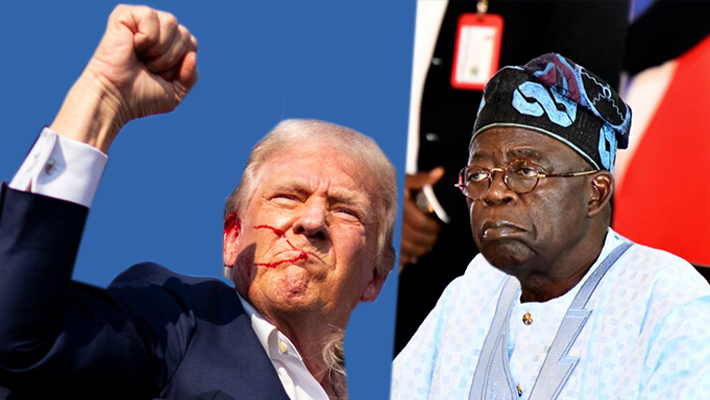
U.S. President Donald Trump has once again stirred global discussion after declaring that Christians in Nigeria face an “existential threat” due to what he described as ongoing attacks by “radical Islamists.”
The controversial statement, made via his social media platform Truth Social, has drawn both praise and criticism across political and diplomatic circles.
In his post, Trump accused the Nigerian government of failing to protect its Christian population, alleging that “thousands of innocent Christians are being slaughtered” across the country.
He announced that the United States would re-designate Nigeria as a “Country of Particular Concern” (CPC) under the International Religious Freedom Act — a status reserved for nations accused of severe violations of religious liberty.
“The United States cannot stand by while such atrocities are happening in Nigeria,” Trump said.
“We stand ready, willing, and able to save our Great Christian population around the World!”
The move signals renewed tension between Washington and Abuja, especially as the CPC designation could lead to sanctions, aid restrictions, or diplomatic reviews depending on how the U.S. administration decides to act.
Trump also tasked U.S. Representatives Riley Moore and Tom Cole to investigate reports of violence against Christians in Nigeria and submit their findings to Congress. Congressman Moore has already voiced support, saying he intends to “lead the charge” on the issue.
This development places Nigeria under renewed American scrutiny, reminiscent of 2020 when the Trump administration first placed the country on the CPC list — a decision later reversed by the Biden administration in 2021.
Officials in Abuja swiftly rejected Trump’s claims, describing them as “one-sided and misleading.” A spokesperson for Nigeria’s Ministry of Information stated that the country’s security challenges are not solely religious, pointing instead to decades-long problems with terrorism, armed banditry, and farmer-herder conflicts that affect both Christians and Muslims.
Analysts in Abuja and Washington have also noted that many victims of violence in northern Nigeria are Muslim, and that framing the crisis purely as Christian persecution oversimplifies the reality of ethnic, economic, and territorial tensions.
Trump’s declaration has been welcomed by several Christian advocacy groups in the U.S., who argue that the Nigerian government has not done enough to protect believers.
However, international observers warn that such framing could heighten sectarian narratives and complicate diplomatic relations between Nigeria and the United States.
Religious leaders in Nigeria have called for a balanced approach that recognizes all victims of violence, regardless of faith, while also addressing the root causes of insecurity.
Under U.S. law, the CPC designation is applied to countries where governments “engage in or tolerate particularly severe violations of religious freedom.” While the move does not automatically impose sanctions, it empowers the U.S. government to take punitive steps, such as restricting non-humanitarian aid or arms sales.
If enforced, this could affect U.S.-Nigeria cooperation on security, trade, and counter-terrorism, particularly as Nigeria remains one of Washington’s most strategic partners in West Africa.
Across Nigerian social media, reactions have been sharply divided. Some citizens, particularly from Christian-majority regions, applauded Trump for “speaking the truth,” while others criticized him for politicizing Nigeria’s internal challenges to appeal to his conservative voter base ahead of the upcoming U.S. elections.
Donald Trump’s renewed criticism of Nigeria underscores how religious freedom continues to play a role in U.S. foreign policy and domestic politics. While his comments have reignited global attention on the security crisis in Nigeria, they also risk inflaming existing divisions if not addressed with care and accuracy.
As Nigeria continues to battle insecurity across multiple fronts, the international spotlight — once again fueled by Trump’s rhetoric — may bring both pressure and opportunity for reform.
1 thought on “Trump Declares Christianity “Under Siege” in Nigeria, Calls for U.S. Action”